
Resources
Reasonable suspicion checklist for supervisors: what to document and what to do next
Calm, consistent steps for documenting observations before reasonable suspicion testing—not diagnoses, not accusations, and not a substitute for your employer handbook.
Reasonable suspicion testing is ordered when trained supervisors observe physical, behavioral, speech, or performance indicators described in your drug-free workplace policy—or DOT reasonable suspicion testing rules where they apply—and note those observations promptly while memories are fresh.
This page is a supervisor guide for observation and documentation. It does not tell you whether someone is impaired or whether a test is legally justified in your situation; your employer policy, training materials, and designated roles (such as HR or a DER for DOT-covered employees) decide when to authorize reasonable suspicion testing.
Use simple notes tied to specific observations and times. That habit protects employees from vague judgments and helps leadership respond consistently when workplace impairment concerns arise.
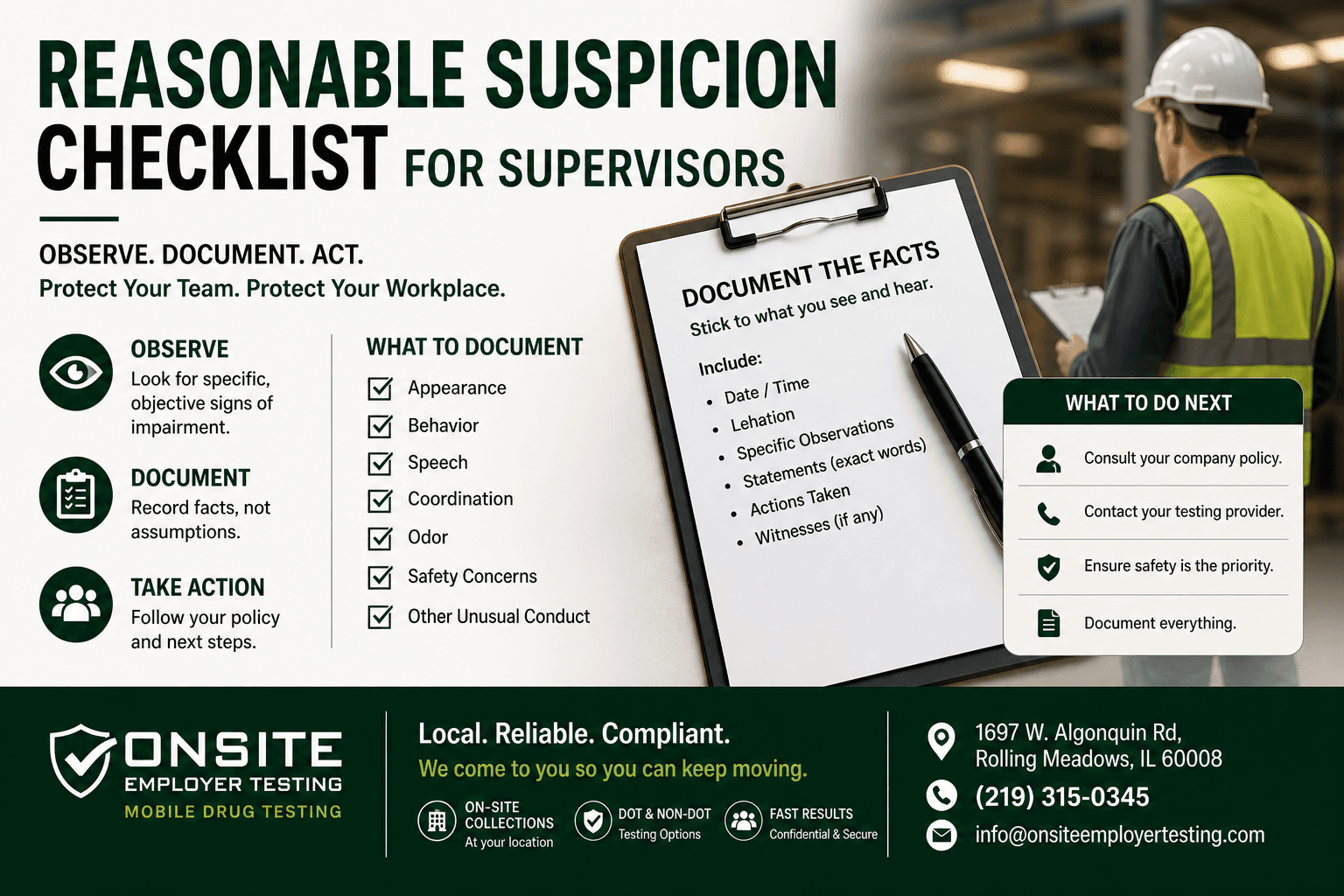
What to observe and document (checklist)
Work through the items that fit your policy wording—not every line applies every time. Contemporaneous notes beat hallway summaries later.
• Who made observations (names and roles) and whether two supervisors are required for alcohol scenarios under your program.
• Date, shift, location (plant floor, yard gate, office suite), and approximate times each observation occurred.
• Objective descriptions—what you saw, heard, or smelled—not guesses about cause or medical labels.
• Changes from the employee’s usual performance or conduct when you have baseline knowledge.
• Who was notified internally (HR, safety, DER, security) and when, following your escalation chart.
• Whether the employee was informed that testing may occur per policy script.
Categories supervisors often document
Group facts under simple headings so reviewers see patterns without drama. These categories mirror how many employer trainings organize workplace impairment observations—they are not medical criteria.
| Area | Examples of factual notes |
|---|---|
| Appearance | Bloodshot eyes, unusual pupil appearance, unkempt appearance inconsistent with norms on site, sweating unrelated to temperature—describe what you saw without naming a condition. |
| Behavior | Extreme mood swings for that individual, uncharacteristic hostility or withdrawal, inability to complete routine tasks, hiding behavior or repeated unexplained absences from duty. |
| Speech | Slurred words, rambling or unusually slow responses when communicating job-critical information. |
| Coordination | Unsteady gait, dropping tools, clumsiness beyond ordinary fatigue, delayed reactions near machinery or vehicles. |
| Smell / odor | Odor of alcohol or cannabis-like odor when relevant and safely observed—not intrusive sniffing or violating privacy rules. |
| Unusual conduct / safety | Bypassing lockout/tagout, ignoring established checks near hazards, or conduct that would alarm a reasonable supervisor even without naming substances. |
Link observations to job duties when possible (“could not verify lock sequence,” “missed three radio callbacks”). That framing keeps attention on workplace risk rather than personality.
What supervisors should do next
• Notify the role your handbook names—often HR, safety, or a DER—before improvising a drug test order unless policy explicitly allows supervisors to trigger collections directly.
• Preserve drafts securely; avoid edits that look like late rewriting of facts.
• Arrange collections promptly once authorized so gaps do not undermine trust or safety conversations.
• Stay respectful and private; restrict discussion to people who need to coordinate logistics.
• DOT-covered scenarios may require specific supervisor counts or alcohol testing sequences—follow DER guidance rather than general habits from non-DOT jobs.
What supervisors should avoid
• Diagnosing substance use or repeating rumors (“everyone says they drink”). Stick to what you directly observed.
• Searching desks or phones without policy clearance from authorized roles.
• Confrontational crowds or humiliation—documentation serves compliance and fairness, not embarrassment.
• Delaying referral because “they might fail”—authorization belongs with trained leaders.
• Promising outcomes (“you’ll be fine”) when HR or labor counsel still needs to review.
Let employer policy and applicable rules decide
Final decisions about reasonable suspicion testing belong with whoever your organization designates—often HR for non-DOT programs and a DER or consortium for DOT-covered testing—guided by policy, training records, and counsel when laws or contracts vary by state or union environment.
This supervisor checklist supports consistency; it does not replace your written program or regulator-specific obligations.
Need collections aligned with your reasonable suspicion process?
Tell us your regions and typical scenarios—we coordinate discreet on-site and mobile collections once HR or your DER authorizes the order. Request a quote or contact us if you are unsure how staging fits your policy.