Services
Hair drug testing for employers
A different detection window than urine or oral fluid—useful when your program design calls for a longer historical picture, not a drop-in for every workplace screen.
Hair drug testing measures drug metabolites embedded in hair over a rough window of months, depending on hair length and laboratory methodology. It does not establish current impairment or same-day use the way some other matrices do; it answers a different question for employers who have a documented, counsel-reviewed reason to use it.
We support employer-directed hair collections with the same chain-of-custody discipline as other modalities—often at your site or a coordinated staging location—once your policy, state law, and third-party administrator confirm hair is authorized for the testing reason you have in mind. Compare program design with Oral fluid drug testing or Nail drug testing when counsel is choosing between long-window matrices.

What hair drug testing is
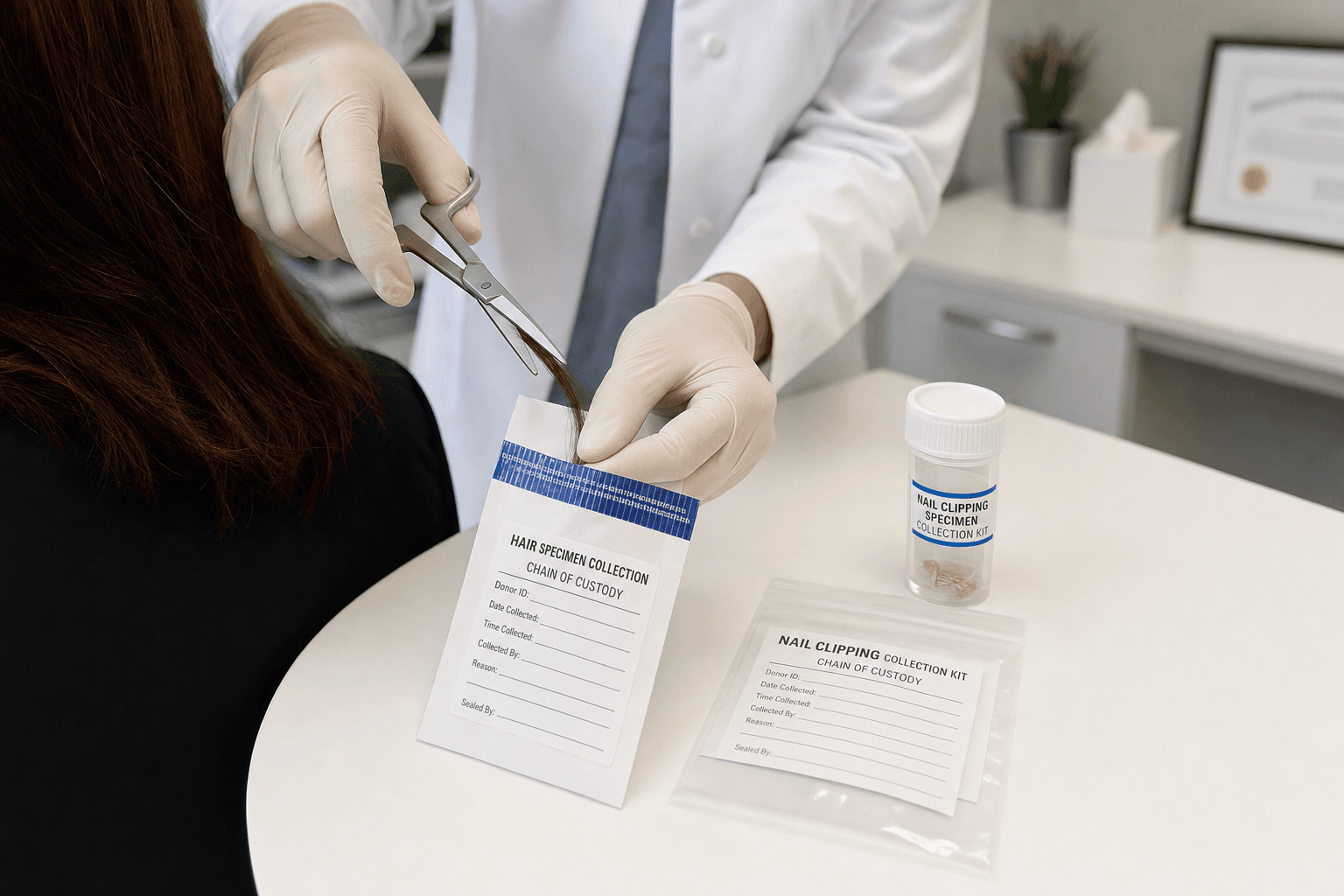
A trained collector cuts or prepares a hair sample per protocol, completes custody paperwork, and sends the specimen to a laboratory for analysis. Panels and cutoffs follow the lab file and your order—not every substance reported in urine is available in hair, and interpretation belongs to your MRO or program rules.
Hair is a specialized modality compared with day-to-day urine or oral fluid programs. Employers typically adopt it for specific hiring tiers, safety-sensitive escalations, or program add-ons after legal review—not as a silent replacement for random pools without updating policy.
When employers typically use hair testing
Pre-employment for certain roles or locations, post-offer contingencies where policy explicitly allows hair, cause testing after documented procedures, and some professional-services or executive hiring protocols. International employers with U.S. operations sometimes standardize on hair where their global policy already expects it—again subject to U.S. state constraints.
Hair is generally a poor fit when you need rapid turnaround for same-shift incidents or when regulations mandate a specific specimen type (for example, many DOT drug tests still specify urine or authorized oral fluid—not hair).
Why mobile or on-site hair collection helps
Hair collection still requires privacy, correct volume, and calm donor communication. Doing collections at your workplace keeps candidates and employees in a familiar environment, lets HR control witness and escort norms, and avoids sending people to unfamiliar cosmetic or clinic settings during work hours.
For distributed hiring, we coordinate windows and collector counts so talent acquisition is not waiting on a single distant lab walk-in.
How hair collections work with us at a high level
Intake confirms the testing reason, authorized matrix, panel, lab routing, and any donor preparation rules from your administrator. On collection day we verify identity, explain the procedure, collect the specimen, seal and label per standards, and release packages for lab processing.
If a donor has insufficient hair, your policy should define next steps—often an alternate matrix. We follow the contingency your TPA or counsel specifies.
Who authorizes hair on the employer side
Typically HR or talent acquisition for hiring workflows, safety or employee relations for escalations, and always the TPA or lab path that can report the panel you ordered. Legal review should precede marketing claims about what hair “proves.” MRO interpretation still governs how results read in your program.
What candidates and employees should expect
Expect a private explanation of how much hair is needed, how the collector cuts or prepares it, and how custody paperwork will read. Candidates should not be surprised by matrix changes at the door—communicate authorized testing in offer contingencies and notices your counsel approves.
Employer situations and industries that choose hair
Energy, manufacturing, and logistics employers sometimes add hair for certain leadership or safety-critical hires. Professional and financial services firms may use hair for specific tiers after legal sign-off. Any use should be consistent with state workplace-testing law and communicated clearly to candidates.
How hair fits DOT versus non-DOT programs
DOT-regulated drug tests for covered employees follow federal specimen and procedure rules; hair is not a substitute for DOT-mandated drug testing modalities. Do not use hair for DOT random, pre-employment, post-accident, or other DOT drug test reasons unless your qualified advisors confirm an exception you are operating under—we have not described one here.
Non-DOT employers may use hair when policy explicitly authorizes it, state law allows, and MRO or result handling is aligned. Blended workforces need clear rules so DOT-covered employees are never hair-tested in violation of federal requirements.
Related reading
Common questions
- Does hair testing show current impairment?
No. Hair reflects a longer historical window. Employers should treat results as consistent with program design and MRO review—not as proof of intoxication at work.
- Can we use hair for random testing?
Only if your written policy and applicable state law authorize hair for randoms and your TPA supports the panel. Many employers keep random programs on urine or oral fluid for operational simplicity.
- What if the donor has very short or treated hair?
Collectors follow protocol for viable sample volume; if hair cannot be collected, your policy should define an alternate specimen. Share those rules during intake.
Request a quote for this program
Share DOT or non-DOT context, sites, headcount, and timelines. We confirm logistics, specimen type, and documentation expectations with your DER or TPA before collection day.