Resources
Oral Fluid vs Urine Drug Testing for Employers
Neither matrix wins every workplace program. The right choice depends on policy, legal review, lab setup, and the operational problem you are trying to solve.
Employers compare oral fluid vs urine drug testing when they redesign a handbook, fix hiring bottlenecks, or plan on-site events where restroom throughput matters as much as the panel name.
This guide focuses on non-DOT workplace programs. Collectors execute the matrix on the order—your policy owners, legal review, and TPA setup decide what that order should say.
Short answer
Neither oral fluid nor urine is automatically better for every workplace program. The right choice depends on your policy, state-law constraints, lab and TPA setup, and the operational problem you are trying to solve.
Fair programs match specimen to authorization, train supervisors on what not to improvise, and document orders. The goal is not picking the newest matrix—it is picking the one your program can run consistently.
When employers usually compare these options
Most employers start this comparison for practical reasons:
Restroom bottlenecks at yards, plants, or hiring events
Observed collection concerns and staging privacy
Faster onsite events with predictable donor flow
Policy redesign during handbook or vendor reviews
Hiring-flow problems when candidates wait too long between steps
Mixed workforces with different testing needs across sites
If your immediate problem is dispatching collectors to a site, start with mobile drug testing intake—matrix choice should be settled before collection day, not debated at the door.
When urine is often the better fit
Urine is often the better fit when:
Your current program is already built around it, with supervisors, applicants, and administrators trained on urine workflows.
Your contracts or policies already specify urine for certain roles or test reasons.
You want a widely familiar workflow across multi-state operations.
Your lab account and documentation are centered on urine panels and MRO conventions you already trust.
You are not trying to solve a staging or restroom problem—urine works fine when logistics are not the bottleneck.
Switching matrices without updating handbooks and orders creates mismatch risk. Urine remains the path of least disruption when paperwork has not caught up to a new idea.
When oral fluid is often the better fit
Oral fluid may be the better fit when:
Restroom access is limited, distant, or slow on the shifts you test most often.
Observed collection practicality matters and chair-side staging fits your sites better than restroom queues.
You want a more predictable onsite flow for hiring events or batch testing.
Your policy and legal review already allow oral fluid for the employee class and test reasons involved.
Your TPA and lab account support it—with the right forms, analytes, and reporting path confirmed in writing.
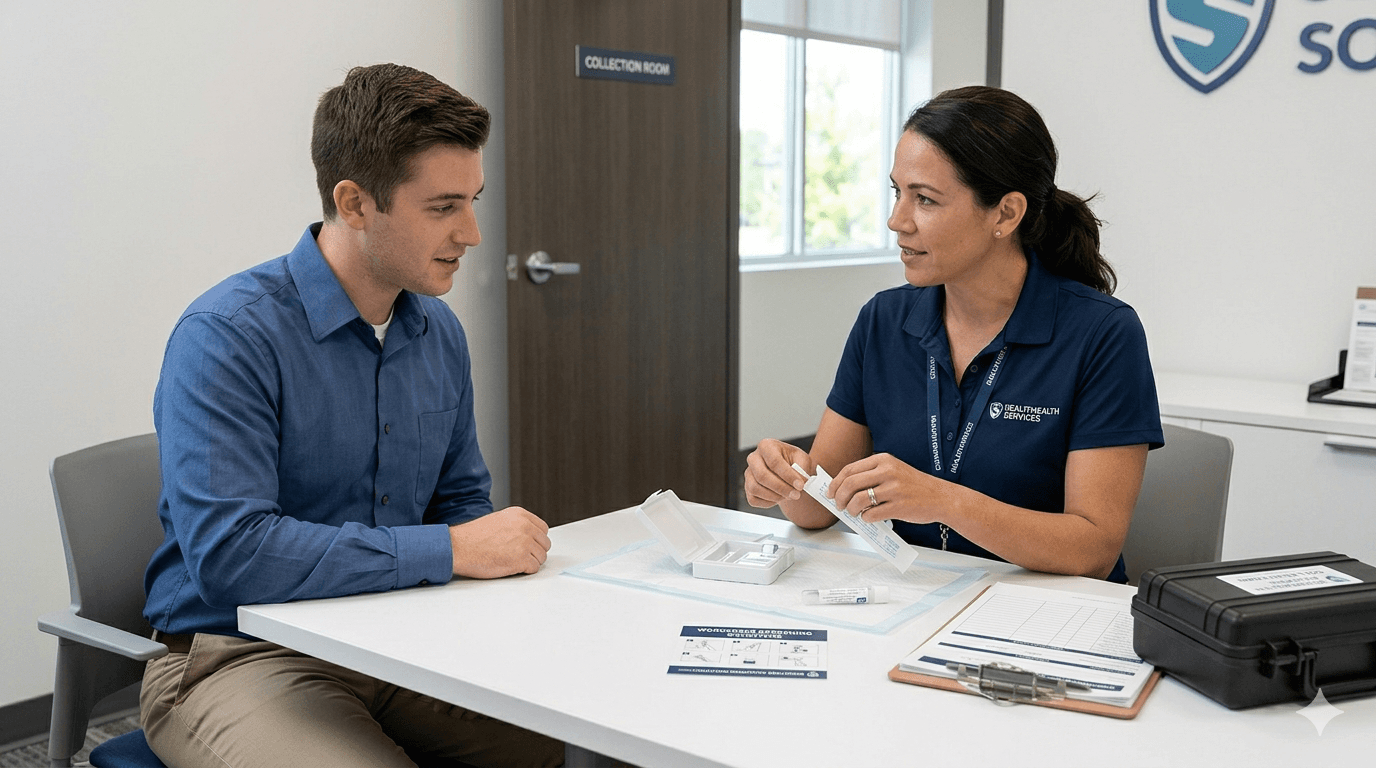
See our oral fluid drug testing service page for how on-site oral fluid collections are staged when your program authorizes saliva.
Operational differences employers notice first
Space and staging
Urine relies more heavily on restroom logistics. Oral fluid may be easier to stage in a meeting room, trailer, or controlled work area when policy allows it.
Sites with tight production floors or shared restrooms often feel urine-heavy even when the collection itself is routine. Oral fluid does not eliminate planning—it changes where donors wait and how observation is staged.
Observation
Observation rules differ by program and specimen type. Employers should not assume the two workflows are interchangeable.
Train supervisors and site leads on what each matrix requires before collection day. Collectors follow the order; employers avoid hallway coaching that mixes procedures.
Panel and reporting differences
Do not assume every oral fluid panel mirrors a urine panel exactly. Verify the actual analytes and reporting path with your administrator.
Cutoffs, menus, and MRO expectations can differ between matrices. Confirm the requisition matches what leadership thinks it ordered.
For DOT employers, stop here first
If any of the employees involved are DOT-covered, use the DOT-specific comparison page instead. DOT authorization is a separate issue and should not be mixed with general workplace policy decisions.
Regulated drivers and other covered staff follow federal rules for authorized specimen types, test reasons, and effective dates. A non-DOT oral fluid policy for warehouse staff does not authorize DOT saliva collections for CMV drivers.
Read DOT oral fluid vs urine for employers before you change hiring scripts or supervisor instructions for regulated populations.
Final takeaway
This is not a "new versus old" decision. It is a policy and operations decision. Choose the matrix that fits your legal framework, your actual sites, and the way your testing program is supposed to run.
Name defaults by scenario in writing, publish who may authorize an exception, and revisit choices after vendor changes or major incidents. Collectors execute what the order says—employers win when the order matches reality.
Compare logistics with your actual orders
Share regions, DOT vs non-DOT mix, and whether you lean oral fluid or urine—we quote on-site and mobile collections matched to the specimen your TPA authorizes.