OnSite Employer Testing logo — on-site and mobile employer drug and alcohol testing services
Quote
Skip to main content

Services

Nail drug testing for employers

A niche alternative matrix for extended detection windows—valuable only when your policy, lab, and legal review explicitly call for nail specimens.

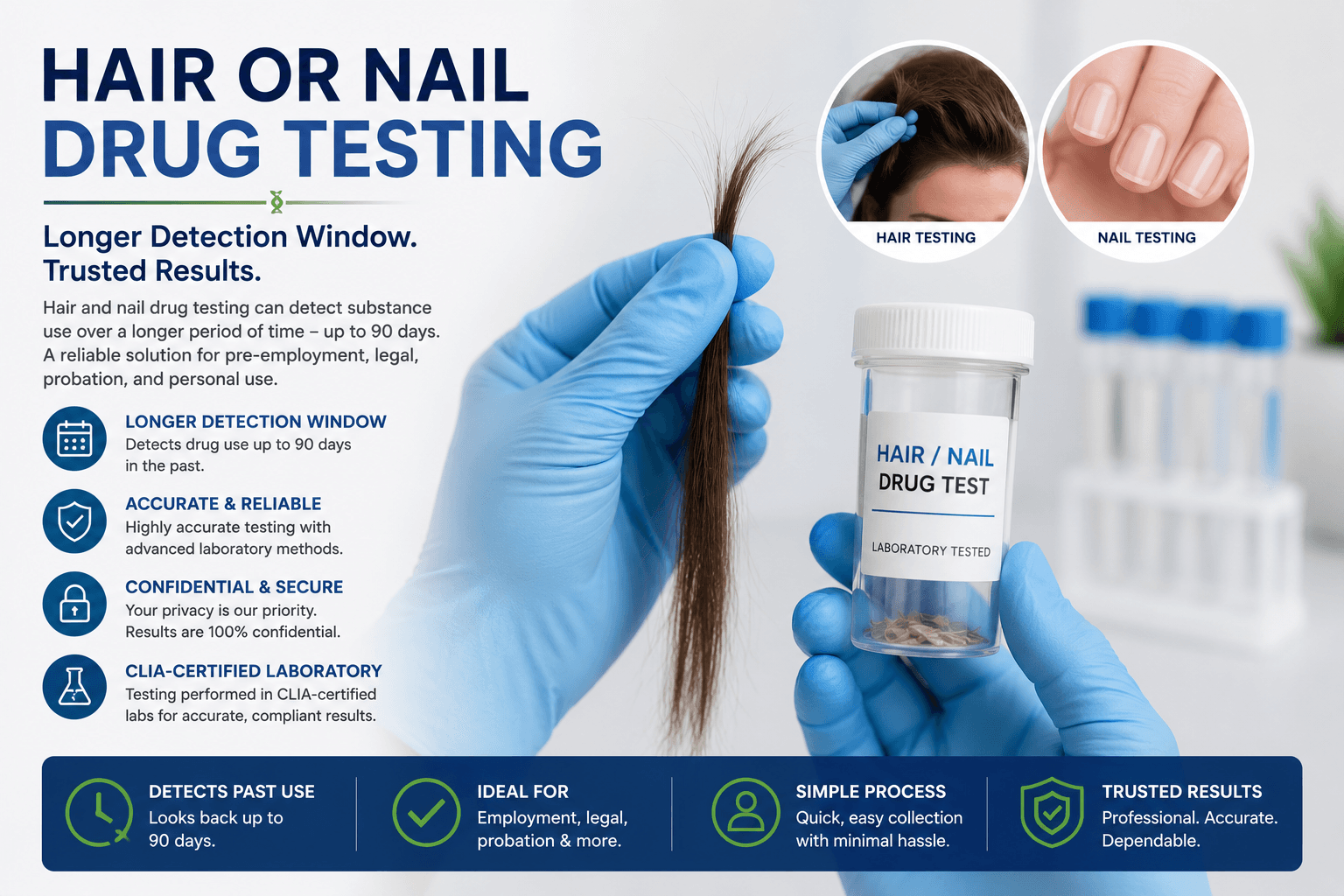
Nail drug testing analyzes drugs incorporated into fingernails or toenails over months of growth, offering a long lookback somewhat analogous to hair in program design—but with its own collection rules, lab limitations, and state-law considerations. It is not a mainstream substitute for urine or oral fluid in typical random testing programs.

Employers who use nail testing usually do so under specialized hiring, monitoring, or escalated cause scenarios with clear documentation. We execute collection and custody once your third-party administrator confirms the matrix and panel are authorized for the testing reason. Program designers often compare nail with Hair drug testing when counsel is weighing long-window matrices.

Employer nail drug test collection: certified collector wearing gloves prepares a fingernail specimen from a donor’s hand across a collection room table, with small scissors, sealed supplies, and custody documentation ready for protocol-compliant clipping and packaging.
Nail collections are discrete and procedure-driven—identity verification, correct clipping length, sealed specimens, and traceable paperwork per your lab kit and TPA.

What nail drug testing is

Collectors obtain clippings or other nail specimens according to laboratory protocol, complete chain-of-custody paperwork, and ship to a lab qualified for nail assays. Available drugs and reporting thresholds depend on that lab’s menu—not every panel mirrors urine, and interpretation still flows through your MRO or program rules.

Nail can reflect exposure over a long window; like hair, it is a poor tool for proving current impairment and is inappropriate where regulations require a specific specimen type.

When employers consider nail testing

Select pre-employment protocols, professional registration or monitoring contexts, and rare internal escalations where counsel and the lab jointly recommend nail instead of or in addition to hair. Operational random testing and same-day incident testing are usually served by other matrices.

If your goal is rapid hiring throughput for broad applicant pools, nail is rarely the right default—Oral fluid drug testing or urine programs usually scale better when policy allows.

Compared to hair: practical differences for HR teams

Both matrices answer longer historical questions than a same-day urine or oral fluid screen, but collection mechanics, donor prep, lab menus, and donor objections differ. Hair may be more familiar to candidates; nail may fit when hair volume is limited or when the lab path prefers clippings.

Neither replaces sound supervisor documentation, reasonable suspicion processes, or DOT-required specimens for covered employees.

Who this is for

Compliance-sensitive hiring teams, professional licensing programs, occupational health partners, and TPAs supporting narrow panels. Frontline supervisors should not add nail ad hoc—authorization belongs in the written program.

Why coordinated on-site collection helps

Nail collection requires privacy, correct technique, and donor cooperation. On-site visits let HR control discretion for candidates and employees, reduce stigma from public clinic visits, and keep documentation consistent with your TPA.

What donors should expect

A private explanation of clipping length, which nails will be collected, and how kits will be sealed. Candidates deserve advance notice when policy requires nail so they are not surprised on day one.

How nail collections work at a high level

Intake confirms authorized matrix, clipping length requirements, panel, and lab kit or shipping rules. Collectors verify identity, explain steps, obtain the specimen, seal and label, and release packages per your administrator.

Cosmetic nail products and damage can affect viability—your lab’s instructions should define donor prep and refusals.

Operational and logistics considerations

Ship windows, temperature instructions, and chain-of-custody signatures must match the kit your lab issues. Multi-site employers should centralize instructions so each branch uses the same contingency language for refusals or insufficient specimens.

Employer situations that use nail specimens

Highly regulated or licensed professions, some healthcare and safety-sensitive hiring escalations, and legal-adjacent programs where nail is explicitly specified. General warehousing or retail employers rarely build nail into baseline policy compared with urine or oral fluid.

How nail testing fits DOT and non-DOT workplace rules

DOT-covered drug tests follow federal specimen requirements; nail is not an authorized substitute for DOT drug testing modalities described in Part 40. Do not route DOT selections to nail collections.

Non-DOT use requires explicit policy language, state law compliance, and candidate notice. Blended workforces need hard separation so regulated employees never receive the wrong matrix.

Common questions

Is nail testing better than hair?

Neither is universally better. Labs and counsel choose based on donor situation, available length or volume, panel needs, and legal strategy. Review Hair drug testing when comparing long-window options.

Can employees refuse nail collection?

Refusal handling follows your policy and state law like other specimens. Document contingencies with your TPA before testing day.

Is nail testing common?

No. Treat it as a specialized option alongside counsel and lab guidance—not a default workplace screen.

Request a quote for this program

Share DOT or non-DOT context, sites, headcount, and timelines. We confirm logistics, specimen type, and documentation expectations with your DER or TPA before collection day.